Friday, 3 December 2010

Christmas Workshop 2010

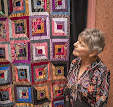
On the left is Dorothy in pressing mode.


Below, right: Chris is concentrating hard on machine-stitching, while Jose is doing I'm not sure what!


It was a good day and everybody completed their Stained Glass Xmas Tree decoration.

Ecumenical Star

My Islamic Star to celebrate A Christian festival!

Patchwork dogs

(Yellow) Sam and (Black) Bren are in their accustomed positions on winter evenings, enjoying the comfort of their own quilts. Two of those shown, admittedly, have been inherited from a previous generation of dogs. Using upholstery scraps to make quilts which can double up as sofa throws for dogs means that I can try out new patterns and methods without using valuable (and expensive) patchwork fabrics, then if I don't like the pattern/method, there's nothing lost. Also, patchwork quilts looks much nicer than plain old dog blankets and the upholstery fabric is hard-wearing and stands up to weekly washings. Altogether, a happy combination, giving pleasure both to dogs and to people.

Saturday, 7 March 2009

Cockermouth Frame Quilt


I recently bought this double-bed-sized Frame Quilt from a Cockermouth dealer. I think the centre is quite unusual, being a Hawaiian-style appliqué cut from a single piece of fabric. In all other respects, this is a classic English Frame Quilt, with nine borders, some of which are pieced, surrounding the centre square. It is quilted with the characteristic All-over Wave pattern found in the regions bordering the Irish Sea. The fabrics are all dress cottons and look, at first sight and without researching any of them, as if they date from the mid-C19th.

The condition of the quilt is fair, with considerable fading on one end. There are a few small holes where the fabric has worn through to reveal the cotton wadding.

The dealer told me that the quilt had been brought to her by a local lady, who said it had belonged to her mother. Of course, the dealer was unwilling to give me the name of the person from whom she'd bought it - I can only assume because she didn't want me to know how much she'd paid for it. (Or am I being cynical?!)

I'm thinking of advertising locally to see if I can find the seller, from whom I might be able to get some provenance.

The quilt is a useful and interesting addition to my small collection of local (i.e. West Coast) quilts since this is the first example of this particular style I've been able to acquire. I'd be interested to hear from anyone who has knowledge of any other Frame Quilts with appliqué centres.

Wednesday, 19 November 2008

A Mysterious Textile


At the 2008 BQSG Seminar I showed a large cotton textile, dated 1906, which I had borrowed from the Design and Textile Archive of Stead McAlpin in Carlisle. The main point of interest was that this large item (108" X108"),printed with a centre design surrounded by borders, was described in the archive records as ‘a quilt’. As far as I can discover so far, there are no surviving examples of either quilts or coverlets of this size and style yet the records show that large numbers of these textiles were made and dispatched during the late 19th and early 20th centuries. So the questions arise: what were they for, how were they used and, even more curiously, where did they go?

After a follow-up visit to the archive, I can at least clarify one aspect of the textile which was puzzling: it is very stiff, almost canvas-like, so it was hard to see how it could ever be quilted in the conventional sense, either by hand or machine, even assuming that was its intended function. I now know that the textile as seen by us is in an unfinished state, i.e. straight from the printing process. It would then have been subjected to a further long processes of treatment to both fix the printing and to soften the fabric. In other words, when it left the mill it would have been in a suitable condition for use as a household textile in whatever capacity. It has been suggested that the reason it remained at the mill, rather than being dispatched, may have been some fault in the printing.

This, unfortunately, doesn’t take us much further in determining the ultimate fate of these textiles, the one I showed being but one of many. One suggestion is that they may have been made for export and, America being a very likely destination for such goods, I'm asking mmbers of the American Quilt History List (QHL) if anyone can cast further light on the subject.
The photos show the top half of the textile and the centre motif respectively.

Monday, 3 November 2008

Mrs. Oxtoby's Quilts


Earlier this year, I was fortunate to be able to acquire four quilts from a local (Wigton) lady, all showing clear evidence of their local provenance in the form of the All-over Wave quilting which is endemic to the NorthWest coast of England and to the geographically contiguous area of Northern Ireland. Two of them are shown on the bed, the other two being a well-washed and worn single Irish Chain quilt in blue and white, and a pink-and-white checkerboard quilt. The Turkey red frame quilt, the top quilt on the bed, is particularly striking, being in excellent condition and completely unfaded.

Mrs. Oxtoby's mother died last year and in clearing out the house prior to sale, the Oxtoby's came across a trunk in the attic containing the four quilts. (Yes, it can still happen!) Members of the family then remembered that the quilts had been given to Mr. Oxtoby's parents on their marriage. The donors were, it was claimed, two sisters and the assumption was that they were also the makers of the quilts. They were the daughters of a prominent member of Wigton society, a book-seller named Thomas McMechan, who lived with his family over his shop.

That is as far as my information goes so far but it's a good start to providing a credible provenance for the quilts. Now that I've completed, and delivered, my paper for the British Quilt Study Group I intend to spend some time delving into the provenance of these quilts.

Friday, 29 August 2008

'Fans in Boxes' or Cheating at Patchwork


These are details of a quilt made as a door curtain ('portiére') for our sitting room. The slightly 3-D effect is created by using dark and light fabrics for the angled 'boxes'.

However, the blocks are not pieced - they were made by attaching the fan blades to blocks of plain silk using fusible webbing. Each blade was then outlined in satin stitch using a green silk thread. A great advantage of this method is that unusual and exotic fabrics can be used; the black arcs are velvet, the 'boxes' are satin, which has been embellished with lines of embroidery, and the fan blades include cottons, brocade, satin and upholstery fabrics.

Quite a few blocks can be created in this way, especially fans and Drunkard's Path blocks.