Showing posts with label English Patchwork. Show all posts

Monday, 14 May 2007

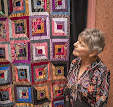
Jeannne's Patchwork Quilt - details


Upper picture shows a detail of the front of the patchwork; lower picture shows the reverse after the papers have been removed.

Jeanne's Patchwork Quilt

Jeanne brought this patchwork to show other Brown House Quilters when she first joined the class. She'd been working away at it, by hand and without any tuition, for ages. It's a classic example of English patchwork, worked over paper templates. When we saw it, everyone was impressed with the artistry she'd brought to the arrangement of the fabrics, so that the simple, basic Tumbling Blocks pattern was transformed into an exciting piece of textile art.

After getting so much positive feed-back from the class, Jean has been inspired to complete the project; she has chosen border fabic which complements the colour and design of the main field and intends to finish the quilt by the tying method.

Thursday, 22 February 2007

Lucy Boston's Patchwork of the Crosses

Lucy Boston's Patchwork of the Crosses, illustrated in The Patchworks of Lucy Boston, is one of the masterpieces of English patchwork. Fifty-six blocks were made using only one template, a long hexagon ( known as a 'church window'), the edges being in-filled with squares and triangles. Her skilful and imaginative use of patterned fabrics create the illusion of infinitely varied blocks. A detail only is shown here - the full coverlet is about 88" square. This patchwork has been an inspiration to many patchworkers, some of whom have emulated Lucy's painstaking English hand-piecing method. I myself have made some blocks using her templates (sides of hexagon are 1") and her tiny stitching. I only managed about 6 blocks before I succumbed to serious repetitive strain injury!
Copies of The Patchworks of Lucy Boston, and other books by and about Lucy, can be purchased from this website:


Wednesday, 21 February 2007

Patchwork Picture - Victorian style

A quintessentially American patchwork pattern - Rolling Star - gets a convincingly Victorian look because it's English hand-pieced in an eclectic mix of cotton, velvet, silk and satin (an old nightie). Piecing this block in these fabrics would have been difficult by any other method. One of a pair framed under glass as mock Victoriana. Viewers tend to assume it really is Victorian and I've given up explaining!

English Patchwork

In the customary New Year work-room clear-out I always find large numbers of UFOs, the motivation for some of which entirely escapes me. I’d like to report that I ruthlessly ditch anything I can’t see a use for, but it’s hard …you never know when something may come in for some yet-to-be devised project! This year, I found a large cache of English patchwork pieces, by which I mean mostly patches tacked over papers ready to be sewn together. It reminded me of how passionate I ‘d been about English patchwork when I first started, nearly 30 years ago. I did use a sewing- machine as well, but it was the fitting together of all those little mosaic pieces by hand that really fascinated me.
My first inspiration was, of course, Avril Colby, shortly to be followed by Lucy Boston. The blue cushion shown was made using the long hexagon template (also known as church window) which Lucy used for her Patchwork of the Crosses. (There is an article about her on my web site which includes a detail from that patchwork.) Using just this one template she created a huge number of different block designs simply by selecting out various pattern elements from the fabrics -what the Americans nowadays call "fussy cutting".I used a border fabric to try to emulate her. Quite a lot of my early patchwork was done in this way, - I was particularly keen on making fabric pictures.
It so happens that my class of ten enthusiastic patchworkers, all keen hand-stitchers, asked particularly to learn English patchwork this month. I'm looking forward to seeing what they make of it, have been working up to now by the American method of piecing. To illustrate the advantages of English patchwork, I've chosen a fairly complex block which has some awkward inset seams, a block which it would be quite possible to make either by machine or by the American hand-sewn method but which, in my opinion, is so much easier to make accurately by English piecing.