Monday, 14 May 2007

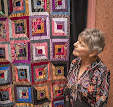
Jeannne's Patchwork Quilt - details


Upper picture shows a detail of the front of the patchwork; lower picture shows the reverse after the papers have been removed.

Jeanne's Patchwork Quilt

Jeanne brought this patchwork to show other Brown House Quilters when she first joined the class. She'd been working away at it, by hand and without any tuition, for ages. It's a classic example of English patchwork, worked over paper templates. When we saw it, everyone was impressed with the artistry she'd brought to the arrangement of the fabrics, so that the simple, basic Tumbling Blocks pattern was transformed into an exciting piece of textile art.

After getting so much positive feed-back from the class, Jean has been inspired to complete the project; she has chosen border fabic which complements the colour and design of the main field and intends to finish the quilt by the tying method.

Wednesday, 11 April 2007

The Guernsey Lily


The inspiration for this little wall quilt comes from a magnificent American quilt now in the St.Peter Port museum on Guernsey, in the Channel Islands. The original quilt is an outstanding example of a style described as 'Classic Floral' by Ricky Clark in her book Quilted Gardens.(Rutledge Hill Press, 1994). Exactly how this quilt came to be in Guernsey is not clear, but it was almost certainly made by a member of the Ogier family, who emigrated to Guernsey in the Eighteenth Century and were among the founders of Guernsey County, Ohio.

The date 1842 and the initials PO are worked into the front of the quilt in trapunto lettering. Surviving correspondence between emigrees and members of the family who emained in Guernsey show that they remained in touch and it is thought that the quilt was probably sent over as a wedding gift.
When the original quilt was brought to my attention, I nick-named it The Guernsey Lily as there is a real flower of that name. (For any botanically-minded readers:Nerine sarniensis, or the Guernsey lily, was named when a ship was wrecked many years ago on Guernsey, the second largest of the Channel Islands, located off the coast of Normandy. Nerine bulbs washed ashore and took root on the island's sandy beaches. Because the ship was Japanese, it was originally believed that they were Japanese in origin, hence another of the common names, Japanese spider lily, but they are actually native only to South Africa.)

In her book, Clark refers to, and illustrates, a similar quilt,as 'Tulip';its provenance points to the probability that it was made by Mary Ogier of Vinton County, Ohio, which suggests that she may also have made the Guernsey version.

The block, of course, is simply one of innumerable variations on the ubiquitous pieced floral block most familiar as'North Carolina Lily', although it seems to have a different alias in every American State where it appears.

Wednesday, 7 March 2007

Mr.Simpson's Dressing Gown - finished!

Front and Back views of the finished dresing gown.

Thursday, 22 February 2007

Reading List 2006


I kept a running list of the books I read in 2006 and arranged them in approximate categories, beginning with Arts and Crafts. Some of these books are old friends I had occasion to visit during the year, either for reference or just because I find them so valuable and/or useful that they are worth re-reading.

M.C.Richards: Centering in Pottery, Poetry and the Person (Out of print and apparently unavailable.) Published in 1962. Re-reading this is pure 1960s nostalgia and yet, and yet... how much of what she says is still true, particularly about the true meaning of education.)

Jonathan Holstein: The Pieced Quilt. An American Design Tradition First published in 1973. Absolutely seminal work for anyone onterested in the history of the patchwork quilt in America.

Bets Ramsey,Merikay Waldvogel: Southern Quilts. Quilts of the Civil War

Faun Valentine: West Virginia Quilts and Quiltmakers

Carla Needleman: The Work of Craft

Suzi Gablik: The Re-Enchantment of Art

Anne Truitt: Daybook. The Journey of an Artist

Henry Glassie: The Spirit of Folk Art

Garard Degeorge and Yves Porter: The Art of the Islamic Tile

Lucy Boston's Patchwork of the Crosses

Lucy Boston's Patchwork of the Crosses, illustrated in The Patchworks of Lucy Boston, is one of the masterpieces of English patchwork. Fifty-six blocks were made using only one template, a long hexagon ( known as a 'church window'), the edges being in-filled with squares and triangles. Her skilful and imaginative use of patterned fabrics create the illusion of infinitely varied blocks. A detail only is shown here - the full coverlet is about 88" square. This patchwork has been an inspiration to many patchworkers, some of whom have emulated Lucy's painstaking English hand-piecing method. I myself have made some blocks using her templates (sides of hexagon are 1") and her tiny stitching. I only managed about 6 blocks before I succumbed to serious repetitive strain injury!
Copies of The Patchworks of Lucy Boston, and other books by and about Lucy, can be purchased from this website:


The Work of Craft

The Work of Craft An inquiry into the nature of crafts and craftsmanship, by Carla Needleman, is an extended meditation on the relationship between Craft and craftsmen. She herself is a potter, and although she doesn't directly focus on textiles as such she shows that the basic material every craftsmen works with is him or her self. Whatever is between one's hands, the clay, the wood, the wool, the fabric, responds to the quality of one's inner state. The product of one's work is not just an object but a way of being.

In reviewing this book, Frederick Franck, author of The Zen of Seeing, said that it is a book "...for anyone whose hands itch to make something - pot, piece of weaving, wooden clog, painting or book - with seriousness, so that it is undivorced from the maker's inner life."

Here are some random quotes taken from Needleman's book:

"The realisation that when I work at my craft in a way that allows each moment to fall of its own weight, without hurrying it or retaining it, such a way of working will produce in me a state of greater sensitivity, can lead me to use this method as an inner technique having as its goal the state itself, solely for the pleasure of it. (P.9)"

"What does it mean that I undertake to study myself? Perhaps it can mean that I extend myself into the Craft, willing to sacrifice any of my own opinions that experience proves false. I undertake to begin a conversation with the craft, to listen to it, to be taught by the effort of trying to understand it. (Pages 12/13)"


Carla Needleman. The Work of Craft. An inquiry into the nature of crafts and craftsmanship. Alfred Knopf. NY. 1979. isbn 0 394 49718 X


Illustration shows 'Railroad Crossing', an 1930s American block pattern attributed to Nancy Cabot.