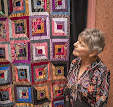
Monday, 30 July 2007

Brown House Quilters - work in progress

It all begins round the kitchen table at The Brown House. Then they take their work home and come back with it all magically finished!
Sometimes they take it really seriously and work hard. But not always!
Notice that the work is fuelled by copious amounts of tea and biscuits.

Thursday, 26 July 2007

Brown House Quilters - Sampler quilts

After many months of enthusiastic work, members of the group have got to the stage when all the blocks have to be arranged, ready for assembling the quilt tops. This isn't as easy as you might think, as anyone who has tried it will tell you. Every time you think you've got it just right, you think that a small adjustment will make it look more pleasing. When you've done that, something else comes to the eye - two dark blocks placed adjacent to each other don't look good, or some of the patterns would look better seperated, or....And so it goes on.


Chris laid all her blocks out on the floor while the rest of us stood round and offered comments - in fact, we agreed that she'd got it about right almost first time. The blocks will be set together with sashings and posts in light and dark blue.

Jennifer's blocks are on a pink and lilac theme, and she's so pleased with them that she says that she'll re-decorate the room for which the quilt is intended, to make it match the quilt!

As well as the traditional American block patterns used, we covered other useful techniques, such as appliqué, bias appliqué and English piecing over papers. Please note that most of these blocks have been sewn by hand using the American patchwork method. That's because most of the members of the group prefer not to use a sewing machine, enjoying the ability to relax in the comfort of an arm-chair while peacefully sewing!

Tuesday, 19 June 2007

Alice's Cushion

While we were on holiday, Alice beguiled a wet day by creating two patterns which, she thought I could make into quilts. I made the first one into this cushion.


This is Alice's original art-work on A4 card.


I photocopied it in monochrome and enlarged it to A3 size.
I marked the outline of each shape using a medium black felt pen and identified the colour on each one.
Then I traced each shape on tracing paper and cut it out. I used the tracing paper shapes as patterns to cut out the shapes in fabric.


I sprayed a piece of calico fabric with temporary fabric adhesive and laid out and pinned the pieces on it. Next, the panel was mounted on wadding and backing and pinned through all three layers. Finally, each shape was outlined with a wide zig-zag stitch which had the effect of anchoring the pattern together and at the same time quilting it. A border was added to make a good-sized cushion.

Thursday, 14 June 2007

Quilts from the Alhambra

Another quilt in my series inspired by Moorish patterns, exemplified by those found on walls, screens, floors and, especially, tiles in The Alhambra Palace at Grenada. The six-pointed interlaced star is one of the simpler designs, easy to re-create in patchwork. Some of the more complex designs could be interpreted in appliqué - but the MOST mathematically complex are impossible to imagine in any form other than the original!

A detail is shown of the centre star. The pattern is created by the 'fusssy cutting' method - which is to say by choosing a particular element of a pattern in the fabric and cutting it out as many times as needed. The best way to do this is by using two joined mirrors - I just bought two mirror tiles from a DIY store and joined them with masking tape. Place the template (in this case a 60 degree diamond) between the mirrors and move them about on the fabric until you see a pattern you like. Mark the template to identify the exact place where it is to be placed on the fabric each time. N.B. that I've used a striped border fabric, which is ideal for this type of patchwork.

This detail shows the edge of the quilt with the border cut from long strips of the original border fabric. Another piece is used for the binding. Machine embroidery on the interlacing strips emphasises the directional nature of the pattern.

The quilt is intended as a wall-decoration and measures 30 inches from side to side.

Monday, 14 May 2007

Jeannne's Patchwork Quilt - details


Upper picture shows a detail of the front of the patchwork; lower picture shows the reverse after the papers have been removed.

Jeanne's Patchwork Quilt

Jeanne brought this patchwork to show other Brown House Quilters when she first joined the class. She'd been working away at it, by hand and without any tuition, for ages. It's a classic example of English patchwork, worked over paper templates. When we saw it, everyone was impressed with the artistry she'd brought to the arrangement of the fabrics, so that the simple, basic Tumbling Blocks pattern was transformed into an exciting piece of textile art.

After getting so much positive feed-back from the class, Jean has been inspired to complete the project; she has chosen border fabic which complements the colour and design of the main field and intends to finish the quilt by the tying method.

Wednesday, 11 April 2007

The Guernsey Lily


The inspiration for this little wall quilt comes from a magnificent American quilt now in the St.Peter Port museum on Guernsey, in the Channel Islands. The original quilt is an outstanding example of a style described as 'Classic Floral' by Ricky Clark in her book Quilted Gardens.(Rutledge Hill Press, 1994). Exactly how this quilt came to be in Guernsey is not clear, but it was almost certainly made by a member of the Ogier family, who emigrated to Guernsey in the Eighteenth Century and were among the founders of Guernsey County, Ohio.

The date 1842 and the initials PO are worked into the front of the quilt in trapunto lettering. Surviving correspondence between emigrees and members of the family who emained in Guernsey show that they remained in touch and it is thought that the quilt was probably sent over as a wedding gift.
When the original quilt was brought to my attention, I nick-named it The Guernsey Lily as there is a real flower of that name. (For any botanically-minded readers:Nerine sarniensis, or the Guernsey lily, was named when a ship was wrecked many years ago on Guernsey, the second largest of the Channel Islands, located off the coast of Normandy. Nerine bulbs washed ashore and took root on the island's sandy beaches. Because the ship was Japanese, it was originally believed that they were Japanese in origin, hence another of the common names, Japanese spider lily, but they are actually native only to South Africa.)

In her book, Clark refers to, and illustrates, a similar quilt,as 'Tulip';its provenance points to the probability that it was made by Mary Ogier of Vinton County, Ohio, which suggests that she may also have made the Guernsey version.

The block, of course, is simply one of innumerable variations on the ubiquitous pieced floral block most familiar as'North Carolina Lily', although it seems to have a different alias in every American State where it appears.