Tuesday, 28 June 2011

Imaginitive use of Drunkard's Path block

One of my p&q pupils has a friend in Ontario, who sent her this table runner. It's actually very simply constructed, using Drunkard's Path blocks in an imaginitive way to produce a very strking design.

The detail on the right shows how it's constructed. Twelve Drunkard's Path blocks are set with six four-patch blocks and triangles at the edges. Clever, eh?

It would make a lovely Christmas hanging or table runner.

Sunday, 10 April 2011

My new 'Comfy' quilt


This my recently-acquired 'Comfy' quilt. For an explanation and history of 'Comfy'quilts go to my website: http://www.quilt.co.uk/

Friday, 3 December 2010

Christmas Workshop 2010

On the left is Dorothy in pressing mode.


Below, right: Chris is concentrating hard on machine-stitching, while Jose is doing I'm not sure what!


It was a good day and everybody completed their Stained Glass Xmas Tree decoration.

Ecumenical Star

My Islamic Star to celebrate A Christian festival!

Patchwork dogs

(Yellow) Sam and (Black) Bren are in their accustomed positions on winter evenings, enjoying the comfort of their own quilts. Two of those shown, admittedly, have been inherited from a previous generation of dogs. Using upholstery scraps to make quilts which can double up as sofa throws for dogs means that I can try out new patterns and methods without using valuable (and expensive) patchwork fabrics, then if I don't like the pattern/method, there's nothing lost. Also, patchwork quilts looks much nicer than plain old dog blankets and the upholstery fabric is hard-wearing and stands up to weekly washings. Altogether, a happy combination, giving pleasure both to dogs and to people.

Saturday, 7 March 2009

Cockermouth Frame Quilt


I recently bought this double-bed-sized Frame Quilt from a Cockermouth dealer. I think the centre is quite unusual, being a Hawaiian-style appliqué cut from a single piece of fabric. In all other respects, this is a classic English Frame Quilt, with nine borders, some of which are pieced, surrounding the centre square. It is quilted with the characteristic All-over Wave pattern found in the regions bordering the Irish Sea. The fabrics are all dress cottons and look, at first sight and without researching any of them, as if they date from the mid-C19th.

The condition of the quilt is fair, with considerable fading on one end. There are a few small holes where the fabric has worn through to reveal the cotton wadding.

The dealer told me that the quilt had been brought to her by a local lady, who said it had belonged to her mother. Of course, the dealer was unwilling to give me the name of the person from whom she'd bought it - I can only assume because she didn't want me to know how much she'd paid for it. (Or am I being cynical?!)

I'm thinking of advertising locally to see if I can find the seller, from whom I might be able to get some provenance.

The quilt is a useful and interesting addition to my small collection of local (i.e. West Coast) quilts since this is the first example of this particular style I've been able to acquire. I'd be interested to hear from anyone who has knowledge of any other Frame Quilts with appliqué centres.

Wednesday, 19 November 2008

A Mysterious Textile


At the 2008 BQSG Seminar I showed a large cotton textile, dated 1906, which I had borrowed from the Design and Textile Archive of Stead McAlpin in Carlisle. The main point of interest was that this large item (108" X108"),printed with a centre design surrounded by borders, was described in the archive records as ‘a quilt’. As far as I can discover so far, there are no surviving examples of either quilts or coverlets of this size and style yet the records show that large numbers of these textiles were made and dispatched during the late 19th and early 20th centuries. So the questions arise: what were they for, how were they used and, even more curiously, where did they go?

After a follow-up visit to the archive, I can at least clarify one aspect of the textile which was puzzling: it is very stiff, almost canvas-like, so it was hard to see how it could ever be quilted in the conventional sense, either by hand or machine, even assuming that was its intended function. I now know that the textile as seen by us is in an unfinished state, i.e. straight from the printing process. It would then have been subjected to a further long processes of treatment to both fix the printing and to soften the fabric. In other words, when it left the mill it would have been in a suitable condition for use as a household textile in whatever capacity. It has been suggested that the reason it remained at the mill, rather than being dispatched, may have been some fault in the printing.

This, unfortunately, doesn’t take us much further in determining the ultimate fate of these textiles, the one I showed being but one of many. One suggestion is that they may have been made for export and, America being a very likely destination for such goods, I'm asking mmbers of the American Quilt History List (QHL) if anyone can cast further light on the subject.
The photos show the top half of the textile and the centre motif respectively.

Monday, 3 November 2008

Mrs. Oxtoby's Quilts


Earlier this year, I was fortunate to be able to acquire four quilts from a local (Wigton) lady, all showing clear evidence of their local provenance in the form of the All-over Wave quilting which is endemic to the NorthWest coast of England and to the geographically contiguous area of Northern Ireland. Two of them are shown on the bed, the other two being a well-washed and worn single Irish Chain quilt in blue and white, and a pink-and-white checkerboard quilt. The Turkey red frame quilt, the top quilt on the bed, is particularly striking, being in excellent condition and completely unfaded.

Mrs. Oxtoby's mother died last year and in clearing out the house prior to sale, the Oxtoby's came across a trunk in the attic containing the four quilts. (Yes, it can still happen!) Members of the family then remembered that the quilts had been given to Mr. Oxtoby's parents on their marriage. The donors were, it was claimed, two sisters and the assumption was that they were also the makers of the quilts. They were the daughters of a prominent member of Wigton society, a book-seller named Thomas McMechan, who lived with his family over his shop.

That is as far as my information goes so far but it's a good start to providing a credible provenance for the quilts. Now that I've completed, and delivered, my paper for the British Quilt Study Group I intend to spend some time delving into the provenance of these quilts.

Friday, 29 August 2008

'Fans in Boxes' or Cheating at Patchwork


These are details of a quilt made as a door curtain ('portiére') for our sitting room. The slightly 3-D effect is created by using dark and light fabrics for the angled 'boxes'.

However, the blocks are not pieced - they were made by attaching the fan blades to blocks of plain silk using fusible webbing. Each blade was then outlined in satin stitch using a green silk thread. A great advantage of this method is that unusual and exotic fabrics can be used; the black arcs are velvet, the 'boxes' are satin, which has been embellished with lines of embroidery, and the fan blades include cottons, brocade, satin and upholstery fabrics.

Quite a few blocks can be created in this way, especially fans and Drunkard's Path blocks.

Sunday, 17 February 2008

Indian Patterns: New work by Barbara Howell

Three framed embroideries by Barbara Howell, part of a series exploring colours and patterns of Indian designs.


Friday, 25 January 2008

The Jewel-Bright Sampler Quilt


For this Sampler quilt, the theme was predominantly reds and greens in jewel-bright colours. There are fifteen blocks set on point and joined with sashings and posts. The triangle in-fills round the edge are a Turkey red print, a repro fabric I bought for another project which I never got round to.
The quilt was put together and quilted by my friend, Debbie, who is a whizz at machine-quilting large quilts. Using nothing more technically sophisticated than her domestic sewing machine, she quilts each individual block to suit the pattern. I Like this way of machine quilting much better than the 'all-over' patterns you get when you send the quilt for long-arm quilting, which to my eye results in a rather deadening effect on the surface and detracts from the individuality of the quilt.

Sunday, 25 November 2007

Jeanne's Patchwork Quilt Completed


Jeanne's amazing Rainbow Tumbling Blocks quilt has been completed and put on her bed. It would really need a full-frontal shot to do it justice as it's difficult to see from this angle how subtley the the colours in the four sections have been blended. Jeanne had started on this major project, all stitched by hand, before she joined Brown House Quilters but was able to get some help and advice in quilting it and finishing it to superb effect.

Thursday, 30 August 2007

Quilts from the Alhambra - Star Octagon


Star Octagon is another recurring pattern in Moorish decoration, used in tiling, screens and many other contexts. It adapts easily to patchwork piecing, only two templates being needed to form the pattern which is built up in squares.

In this version I've used a border fabric to add complexity to the design, as you can see in the detail shown below.

Tuesday, 21 August 2007

Festival of Quilts 2007 - Bob Adams


Apart from the pleasure of catching up with old friends, and of seeing new work by people whose progress I've been following for years, every FOQ holds exciting possibilities for encountering artists who may be well-established but who are new to me. This year it was the artist Bob Adams whose quilted textiles proved to be a revelation.

Do you know the story The Twelve Dancing Princesses, by the Brothers Grimm?
Blue Trunks, shown here with Bob's permission, immediately transported me into the magical landscape through which the princesses passed on their way to illicit rendevous with their dancing partners. It has a slightly eerie, unreal atmosphere; it is a landscape which we can recognise but yet makes us feel a little uneasy.

All Bob's quilted textiles are suffused with atmospheric light - the quilts in the series based on observations of the phases of the moon in particular reveal a truthful observation of celestial phenomena which is transcended and transfomed by the subtle play of light and colour.

As so often the case with textile art, illustrations cannot do justice to the work. The texturised surfaces add depth and complexity to the graphic images: seen 'for real', these pieces express the sheer pleasure and satisfaction which the artist finds in using fabric and stitch. In her book, The Work of Craft, Carla Needleman says this: 'The beauty of the object derives from the quality of the work that went into it. ' Bob Adam's textiles are beautiful, and beautifully crafted. Find out more about him on:http://www.bobadamsart.com/index.htmldamsart.com/index.html

Sunday, 5 August 2007

Heritage Quilters visit The Brown House

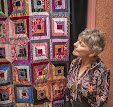
Heritage Quilters of Carlisle visited The Brown House on 31st July. Here we are, inspecting some quilts in my attic work-room. This one is a Trailing Stars scrap quilt. Luckily, the appalling weather we'd had the previous day relented and the party were able to look at the garden as well. Somehow, interest in gardens and quilts seems to go together so most people who come to visit the one, also want to see the other!

Monday, 30 July 2007

Brown House Quilters - work in progress

It all begins round the kitchen table at The Brown House. Then they take their work home and come back with it all magically finished!
Sometimes they take it really seriously and work hard. But not always!
Notice that the work is fuelled by copious amounts of tea and biscuits.

Thursday, 26 July 2007

Brown House Quilters - Sampler quilts

After many months of enthusiastic work, members of the group have got to the stage when all the blocks have to be arranged, ready for assembling the quilt tops. This isn't as easy as you might think, as anyone who has tried it will tell you. Every time you think you've got it just right, you think that a small adjustment will make it look more pleasing. When you've done that, something else comes to the eye - two dark blocks placed adjacent to each other don't look good, or some of the patterns would look better seperated, or....And so it goes on.

Chris laid all her blocks out on the floor while the rest of us stood round and offered comments - in fact, we agreed that she'd got it about right almost first time. The blocks will be set together with sashings and posts in light and dark blue.

Jennifer's blocks are on a pink and lilac theme, and she's so pleased with them that she says that she'll re-decorate the room for which the quilt is intended, to make it match the quilt!

As well as the traditional American block patterns used, we covered other useful techniques, such as appliqué, bias appliqué and English piecing over papers. Please note that most of these blocks have been sewn by hand using the American patchwork method. That's because most of the members of the group prefer not to use a sewing machine, enjoying the ability to relax in the comfort of an arm-chair while peacefully sewing!

Tuesday, 19 June 2007

Alice's Cushion

While we were on holiday, Alice beguiled a wet day by creating two patterns which, she thought I could make into quilts. I made the first one into this cushion.


This is Alice's original art-work on A4 card.


I photocopied it in monochrome and enlarged it to A3 size.
I marked the outline of each shape using a medium black felt pen and identified the colour on each one.
Then I traced each shape on tracing paper and cut it out. I used the tracing paper shapes as patterns to cut out the shapes in fabric.


I sprayed a piece of calico fabric with temporary fabric adhesive and laid out and pinned the pieces on it. Next, the panel was mounted on wadding and backing and pinned through all three layers. Finally, each shape was outlined with a wide zig-zag stitch which had the effect of anchoring the pattern together and at the same time quilting it. A border was added to make a good-sized cushion.

Thursday, 14 June 2007

Quilts from the Alhambra

Another quilt in my series inspired by Moorish patterns, exemplified by those found on walls, screens, floors and, especially, tiles in The Alhambra Palace at Grenada. The six-pointed interlaced star is one of the simpler designs, easy to re-create in patchwork. Some of the more complex designs could be interpreted in appliqué - but the MOST mathematically complex are impossible to imagine in any form other than the original!

A detail is shown of the centre star. The pattern is created by the 'fusssy cutting' method - which is to say by choosing a particular element of a pattern in the fabric and cutting it out as many times as needed. The best way to do this is by using two joined mirrors - I just bought two mirror tiles from a DIY store and joined them with masking tape. Place the template (in this case a 60 degree diamond) between the mirrors and move them about on the fabric until you see a pattern you like. Mark the template to identify the exact place where it is to be placed on the fabric each time. N.B. that I've used a striped border fabric, which is ideal for this type of patchwork.

This detail shows the edge of the quilt with the border cut from long strips of the original border fabric. Another piece is used for the binding. Machine embroidery on the interlacing strips emphasises the directional nature of the pattern.

The quilt is intended as a wall-decoration and measures 30 inches from side to side.

Monday, 14 May 2007

Jeannne's Patchwork Quilt - details


Upper picture shows a detail of the front of the patchwork; lower picture shows the reverse after the papers have been removed.